Description
This MulticompX board an FPGA based system, originally intended to implemement David Conroy’s PDP-10/X. It does that, and has since been expanded to implement other systems such as Grant Searle’s Multicomp.
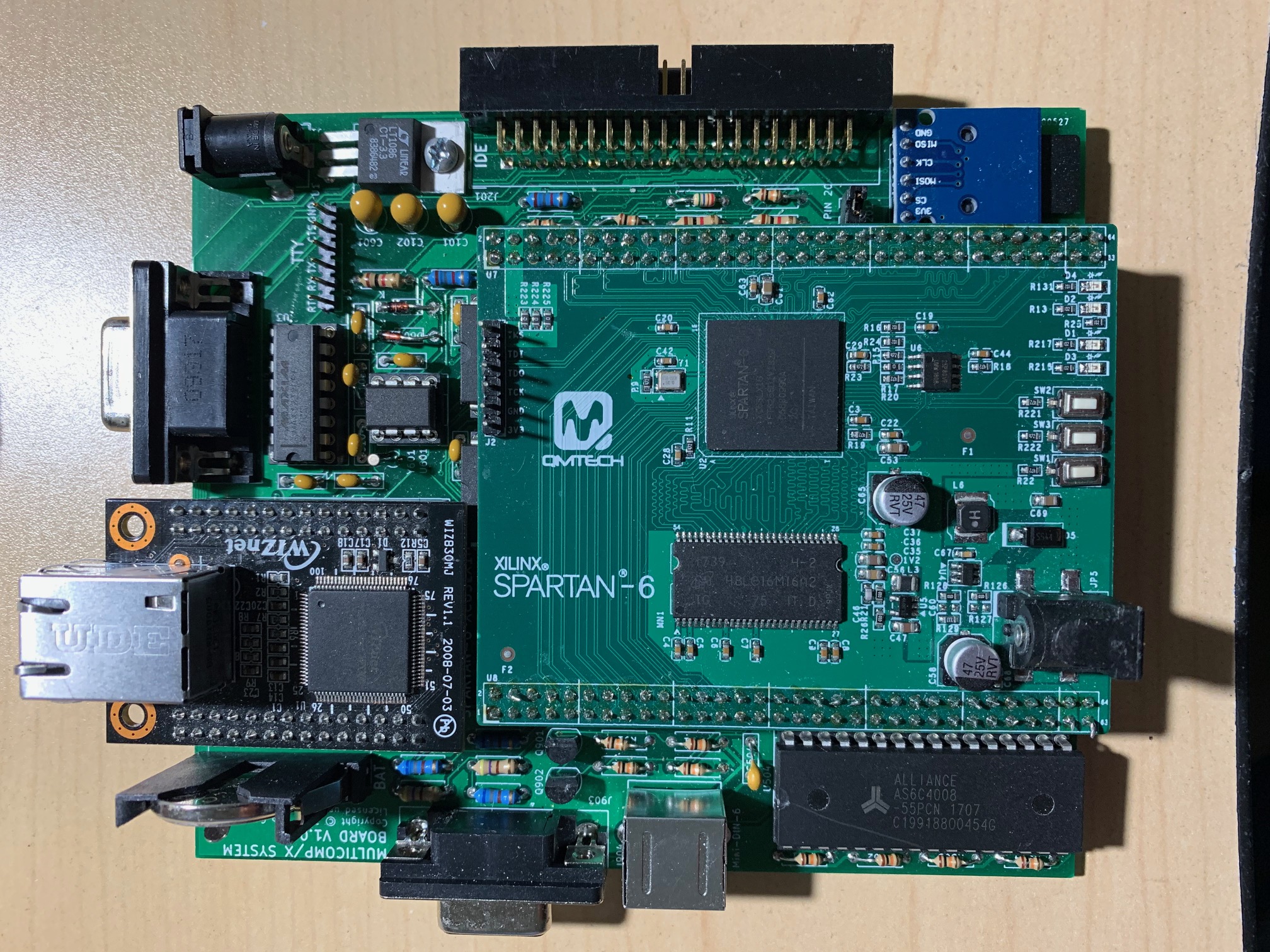
Hardware Features
- Supports the QMTECH Spartan-6 (with SDRAM) board (and clones). This board contains a Xilinx XC6SLX16 chip with about 15K logic elements (LE), about 72K on-board SRAM, and 108 I/O pins. The board is designed to be pin compatible with other QMTECH boards including some of the Altera ones, but I have not used one of those yet. The FPGA board also has a 1MB Serial ROM. This serial ROM is used by the PDP-10/X board. It could be used by Multicomp but currently is not.
- 2.5 MB of SRAM (5x 512KB by 8 SRAM chips)
- A serial port that can be used as a traditional RS-232 port with a MAX3232 chip, or used via a TTL compatible 6-pin header.
- DS1337 I2C Real Time Clock, with coin-cell battery backup (PDP-10/X support only)
- 40-pin IDE port (PDP-10/X support only, could be used as general GPIO in a Multicomp system)
- WizNet W5300 Ethernet support (PDP-10/X only)
- VGA, PS/2 (5V & 3.3V) and SD card interfaces (Multicomp only)
The board uses a standard 5V/2A wall-wart DC power supply with a 5.5mmx2.1mm connector jack.
Software Support
- As a PDP-10/X, the system runs the Incompatible Timesharing System (ITS) for its operating system. ITS is a historic system developed by MIT in the 1960s. Conroy ported ITS to his system.
- As a Z80 Multicomp, the system can run various versions of the CP/M and a BASIC interpret.
- As a 6809 Multicomp, the system can run CUBIX, FUZIX, and NITROS9.
- As a SocZ80 Multicomp, the system can run CP/M and FUZIX(?).
History
David Conroy has created a (customized) PDP10-on-FPGA system which he calls the PDP-10/X, and has extensively documented his work there. In October 2018, he made an archive of the development environment of this system available to a member of the RetroBrewComputers.org community, who posted that archive here.
In that thread, there were efforts to use some of Conroy’s existing boards and to use newly manufactured boards to create a working system. However, both approaches required soldering a 208-pin 0.5mm pitch TQFP package for the FPGA, which is challenging to say the least.
I noticed that the same FPGA, a Xilinx Spartan 3E, was available as a development board from WaveShare.com, so no SMT soldering required. (They make the same board available on eBay and AliExpress). After checking that enough pins were available on the FPGA board, I set out to create a new system board in KiCad. I eventually got that redesign of the system board to work, and posted my results in that thread.
Since then, I have changed out the FPGA to use a Spartan 6 board. This board is cheaper than the Spartan 6 board and contains a larger FPGA. To make the system board more versatile, I’ve added Multicomp compatible peripherals (VGA port, PS/2 port and SD card slot).
Acknowledgements and Licenses
For the PDP-10X, thanks to David Conroy for making his extensive work available. I’ve simply reimplemented his System Board in KiCad and added some Multicomp compatibiilty. But all of the Verilog to implement the PDP-10/X is his work.
For Multicomp, thanks to Grant Searle for making the original system available. His work was published with the following license:
“By downloading these files you must agree to the following: The original copyright owners of ROM contents are respectfully acknowledged. Use of the contents of any file within your own projects is permitted freely, but any publishing of material containing whole or part of any file distributed here, or derived from the work that I have done here will contain an acknowledgement back to myself, Grant Searle, and a link back to this page. Any file published or distributed that contains all or part of any file from this page must be made available free of charge.” http://searle.x10host.com/Multicomp/index.html, retrieved 01/27/2020.
Thanks to Rienk Koolstra (rhkoolstar) for his useful extensions to the Z80 Multicomp MC-2G-1024 system. He also provided me a PS/2 connector footprint when I could not find a decent one.
(If there is no license mentioned for the above works, it’s because I could not find one. Please send corrections.)